
Valenciennes
Before the Stone: The Ancient Beginnings of Valenciennes
Valenciennes started as an open, untamed landscape of water and mud. Long before it was a heavily fortified stronghold wrapped in stone, and centuries before it became an industrial powerhouse, the city was defined entirely by its geography.
To understand how this city came to be, we have to look at the raw natural canvas that drew people to this corner of northern France in the first place. The grand story of Valenciennes does not begin with architects, kings, or military masterminds; it begins with two rivers, a sprawling marshland, and a natural landscape that offered both a golden opportunity for survival and a dangerous invitation to invaders.
1. The Prehistoric Marshlands
Thousands of years ago, during the Neolithic and Bronze Ages, the site of modern Valenciennes was a shifting, labyrinthine delta. Here, the wild river Scheldt (Escaut) met one of its key tributaries, the Rhônelle.
Before human engineering took control, this area wasn't a solid riverbank; it was an intricate network of wetlands, alluvial islands, and peat bogs. For prehistoric humans, this water-logged landscape was a vital sanctuary. Archaeological digs across the local region have unearthed ancient flint tools, prehistoric pottery, and animal bones—proving that nomadic hunters and early farmers used these river islands as a rich source of fish, game, and heavy timber.
2. The Gallo-Roman Crossroads
As agricultural communities settled down, the strategic value of the Scheldt Valley became clear. When the Roman Empire conquered Gaul in the 1st century BC, they established their regional capital nearby at Bagacum (modern-day Bavay).
The marshy basin where Valenciennes sits became a crucial Roman intersection. The clay-rich soils left behind by the flooding rivers were perfect for manufacturing, prompting the Romans to establish small agricultural villas and pottery workshops. The Scheldt served as a natural north-south commercial highway, funnelling trade, pottery, and resources right through this specific bottleneck in the valley.
3. The "Valley of Swans" and the Royal Villa
Following the fall of Rome, the settlement truly began to take its distinct shape under the Frankish Merovingian and Carolingian dynasties.
According to poetic local legend, the name Valenciennes stems from Val des Cygnes (the Valley of Swans), named for the wild white birds that nested in the quiet bayous of the Rhônelle and the Scheldt. Historically, it more likely derives from Valentinianae, a vast imperial estate belonging to a Gallo-Roman landowner named Valentinus.
By 693 AD, the town made its very first appearance in the written historical record. A charter signed by the Frankish King Clovis II identifies it not as a city, but as a thriving royal villa—a central trading post and agricultural hub where merchants gathered to exchange textiles, crops, and artisan goods along the water's edge.
[Prehistoric Delta] ➔ [Gallo-Roman Clay Kilns] ➔ [Carolingian Royal Villa] ➔ [The First Earthworks]
4. The Viking Raids and the First Earthworks
By the 9th century, the open river wealth of Valenciennes caught the attention of invaders. Viking longships began rowing up the Scheldt from the North Sea, pillaging vulnerable, unfortified river towns across northern Europe.
The people of Valenciennes faced a harsh reality: the same waterways that had made them rich now made them completely defenseless. To survive, the inhabitants had to fundamentally alter their natural landscape. They began digging deep artificial ditches, building wooden palisades, and using the waters of the Rhônelle and Scheldt to create their very first primitive moats.
The open, peaceful valley was gone forever. By forcing the local rivers into defensive channels, the early settlers took their first step toward building a massive, tight cage of defense—a choice that would trap the city within its own borders for the next thousand years.
5. The Imperial Borderland (10th – 11th Century)
Following the collapse of the Carolingian Empire, Europe fractured into a complex patchwork of feudal territories. By the 10th century, a highly volatile political border settled right along the Scheldt River.
Valenciennes found itself thrust into a position of intense geopolitical importance. The river became the official dividing line between two massive rivals: the Kingdom of France to the west, and the Holy Roman Empire to the east. Because the city sat on the imperial side of the river, the German emperors recognized it as a crucial frontline outpost.
In 1006, Emperor Henry II took control of the city and began heavily upgrading its fortifications. The crude earth-and-wood palisades built to keep the Vikings out were systematically replaced by thick, stone walls and heavy square towers. The city was no longer just a trading post; it was a militarized gateway.
6. The Rise of the Counts of Hainaut and the Great Fire
By the late 11th century, Valenciennes became the crown jewel of the County of Hainaut. The Counts of Hainaut realized that to maintain a powerful stronghold against French expansion, they needed a wealthy, loyal population to fund and defend the walls.
In 1114, after a catastrophic fire destroyed much of the early wooden settlement, Count Baldwin III granted the citizens of Valenciennes a groundbreaking charter. This document established a commune—giving the local merchants significant legal independence, self-governing rights, and the authority to collect taxes to maintain their own defenses.
With this newfound freedom, the city entered a golden medieval age. The population surged, and the city began to construct its first major stone monuments, including the early foundations of what would eventually become the Béguinage Quarter and the ancient Quartier Saint-Géry.
The stone cage thickens: Feudal rivalries transformed the river valley into a massive geometric fortress.. Source: Sepia Times / Sepia Times/Universal Images Group via Getty Images
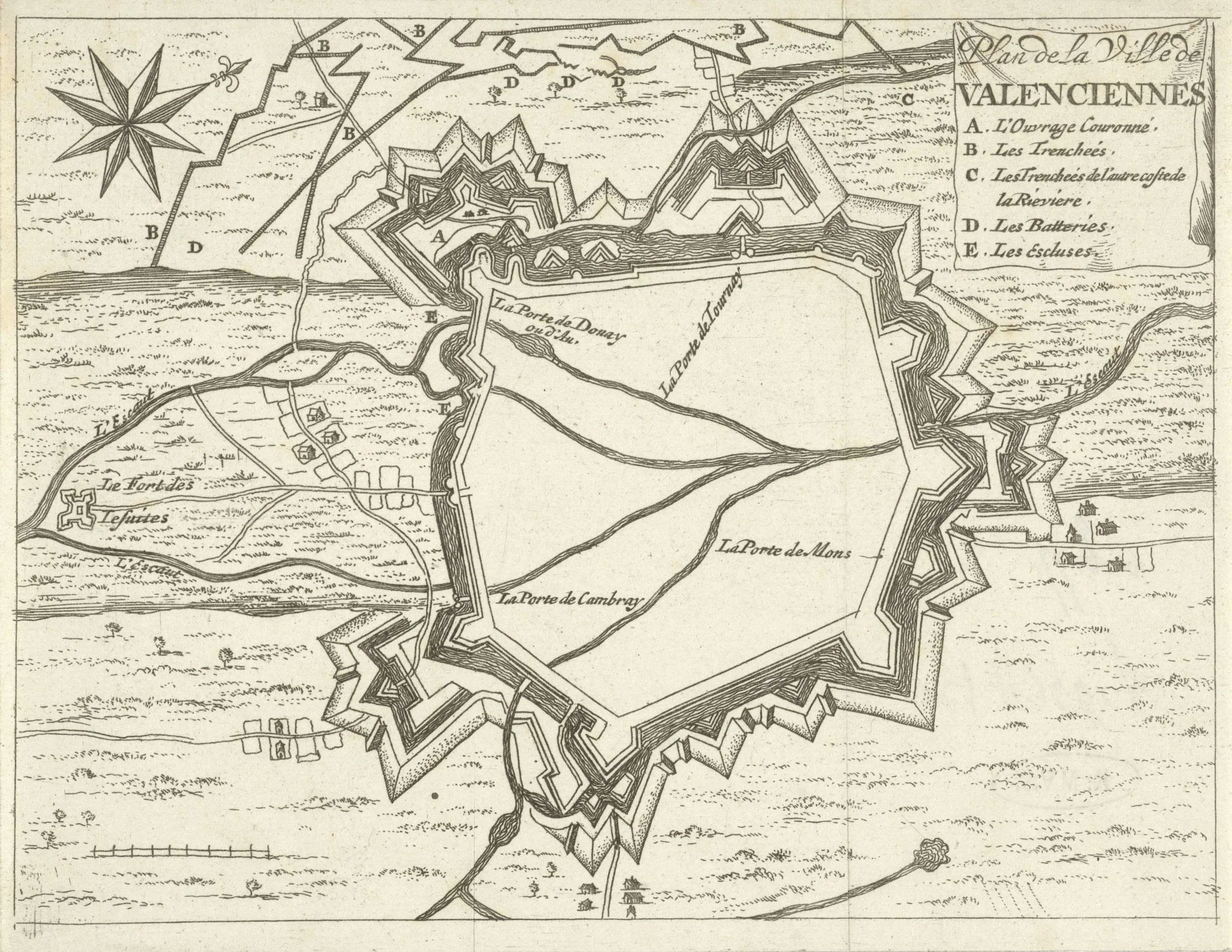
Vauban's master plan: A complex web of earth, stone, and water that completely hemmed in the city.. Source: Sepia Times / Sepia Times/Universal Images Group via Getty Images
7. The Textile Boom: Lace, Linen, and Wealth
With its self-governing charter and its position on a major river highway, medieval Valenciennes transformed into an economic titan. The city became a powerhouse of the Flemish and European textile trade.
Valenciennes Lace: Local artisans developed an intricate, incredibly fine bobbin lace technique that became a luxury status symbol across European royal courts.
Sayetterie and Linens: The city's weavers produced high-quality combed wool and fine linens that were shipped from the Scheldt straight to international markets.
This explosion of wealth directly influenced the shape of the city. Rich merchant guilds built magnificent, timber-framed townhouses and sprawling workshops along the riverbanks. But because the stone walls built by the Counts of Hainaut strictly dictated the city's boundaries, every single new house, workshop, and marketplace had to be shoehorned into the existing grid. The medieval core began to tighten, packing people and industries into a dense, vertical maze of cobblestone alleys.
8. The Spanish Iron Fist (16th Century)
The wealth of Valenciennes made it an irresistible prize for Europe’s great empires. Through a series of royal marriages and dynastic successions, the County of Hainaut—and with it, Valenciennes—was absorbed into the vast global empire of the Spanish Habsburgs.
Under Spanish rule, the city’s defensive role intensified dramatically. During the 16th-century European Wars of Religion, Valenciennes became a hotbed of early Calvinist resistance. In 1567, Spanish forces led by the ruthless Duke of Alba besieged the city, violently crushing the rebellion.
To ensure the city could never rebel again and could withstand the increasingly powerful cannons of the French kingdom, Spanish engineers radically updated the fortifications. They began replacing the tall, thin medieval stone walls with low, incredibly thick earthen ramparts and stone-faced bastions designed to absorb heavy artillery fire.
The city was now completely locked inside an unyielding military ring—setting the exact stage for the arrival of the French armies, the engineering genius of Vauban, and the tight, suffocating pressure cooker that the citizens of Valenciennes would endure until the walls finally fell centuries later.
9. The French Conquest and the 1677 Siege
By the mid-17th century, King Louis XIV of France—the "Sun King"—was deeply obsessed with expanding his borders northward to create a buffer zone protecting Paris. Valenciennes, as the primary Spanish stronghold blocking his path, was the ultimate prize.
In March 1677, French forces launched a massive, meticulously planned siege against the city. Louis XIV did not just send soldiers; he brought along his top military strategist and engineer, Sébastien Le Prestre de Vauban. After an intense and bloody assault, French forces breached the Spanish lines. Valenciennes surrendered, and the Treaty of Nijmegen formally annexed the city to France.
The city had changed hands for the last time, but its identity as a frontline shield was only amplified. Louis XIV immediately tasked Vauban with a singular, monumental mission: turn Valenciennes into an absolutely impregnable fortress.
Vauban's master plan: A complex web of earth, stone, and water that completely hemmed in the city.. Source: Sepia Times / Sepia Times/Universal Images Group via Getty Images
10. Vauban’s Masterpiece: The Fluid Trap
Vauban looked at the ancient landscape of Valenciennes—the very same marshy river junction that attracted prehistoric hunters—and weaponized it on an unprecedented scale.
He didn't just build stone walls; he engineered a complex, deeply integrated military ecosystem:
The Star Fortress: He enveloped the town in a massive ring of geometric bastions, hornworks, and deep ditches, specifically angled to eliminate blind spots and deflect cannon fire.
The Hydraulic System: Utilizing the natural flow of the Scheldt and the Rhônelle rivers, Vauban constructed an elaborate network of defensive sluices and water gates (including upgrades to structures like La Tour de la Dodenne). In the event of a siege, the garrison could flood the low-lying plains outside the city, creating an impassable sea of mud to drown enemy artillery.
This engineering marvel completely stabilized France’s northern border. However, it also snapped the lock shut on the people living inside. The military zone extended well outside the walls, meaning no permanent structures could be built on the open plains beyond the ramparts. Valenciennes was officially frozen in time and space.
11. The Industrial Spark Within the Walls (18th – 19th Century)
Even as the city was physically choked by Vauban's defense ring, the world inside was moving forward at a breathless pace. In 1734, rich veins of coal were discovered nearby in Anzin, sparking an industrial boom that turned the region into the beating heart of French coal mining and heavy metallurgy.
People from rural areas flooded into Valenciennes looking for work in the factories, foundries, and workshops. But because the city was banned from expanding outward past its military perimeter, it faced a terrifying population density crisis.
Every square inch of the historic core was exploited. Elegant medieval gardens were paved over. Tall, narrow brick tenements were built over old alleys, completely blocking out daylight. The air became thick with coal soot, sanitation plummeted, and the open marshes that once provided clean water were now polluted by industrial runoff. The city had become a pressure cooker, suffocating under the weight of its own historical defense system.
12. The Breaking Point: Smashed Stone and the Great Expansion (1891–1893)
By the late 19th century, military technology had completely evolved. The invention of rifled artillery meant that stationary stone ramparts and earthen bastions could no longer protect a city from modern, long-range explosive shelling. Vauban's masterpieces were suddenly rendered obsolete.
For the citizens of Valenciennes, this tactical shift was the miracle they had been waiting for. The walls were no longer a shield; they were a death sentence for the city's future, choking its people and physically blocking modern railways from entering the center.
This sparked the great urban revolution of 1891 to 1893. When the French government finally signed the decree to decommission the fortress, workers enthusiastically smashed through the centuries-old military gates. As the massive stone ramparts crumbled into the old moats, they left behind a cleared ring of land twice the size of the original historic core. A thousand years of confinement evaporated in a matter of months, launching a frantic, golden era of expansion.
13. The "Athens of the North" Takes Shape
Suddenly free to breathe, Valenciennes didn't just grow; it transformed into a cultural and architectural showcase. The city used its newly cleared outer ring to construct sweeping, tree-lined boulevards and open public spaces that purposefully rejected the cramped, dark design of the old medieval core.
On the eastern edge, the old defensive moats fed by the Rhônelle River were re-engineered into the lush, English-style Parc de la Rhônelle in 1904. Right next to these new green spaces, the city erected the monumental Musée des Beaux-Arts to celebrate its staggering artistic legacy, housing works by legendary local masters like Antoine Watteau and Jean-Baptiste Carpeaux. This dense concentration of fine art, elegant Haussmann-style townhouses, and civic pride earned Valenciennes its enduring nickname: the "Athens of the North."
Meanwhile, the industrial frontier exploded outward. Because the Gare de Valenciennes (the train station) had been forced to sit out on the open plains away from the old walls, the demolition allowed the city center to finally connect to the rail network, anchoring a massive wave of new workshops and dense, energetic neighborhoods.
14. Tragedy and Rebirth: The 20th Century Scars
The 20th century brought a brutal reminder of Valenciennes’ ancient vulnerability as a strategic northern crossroads. Positioned squarely in the path of invading forces during both World Wars, the city paid a horrific price.
The darkest chapter arrived in May 1940. During the opening stages of World War II, a catastrophic fire sparked by intense combat tore through the absolute heart of the city. For days, the historic center burned out of control. When the smoke finally cleared, nearly the entire medieval core was reduced to ash and rubble. Miraculously, only the grand 17th-century stone facade of the Hôtel de Ville (Town Hall) survived the flames, standing like a lonely shield amid the destruction.
The post-war era was defined by a massive, resilient effort to rebuild. Throughout the 1950s, architects constructed a completely new, modernized municipal complex behind the surviving historic facade on the Place d'Armes, creating the Coeur de Ville (Heart of the City) we see today.
15. Valenciennes Today: A Green and Connected Future
As heavy coal mining and traditional metallurgy wound down in the late 20th century, Valenciennes had to reinvent itself yet again. It pivoted from a smoke-stacked industrial hub into a modern center for sustainable transport, university research, and digital design.
Today, the city has gracefully reconciled its turbulent history with its natural origins. If you travel further south to neighborhoods like Le Vignoble, you find the city's outer growth beautifully anchored by the massive Étang du Vignoble(Vignoble Lake). What was once part of a marshy, wild river system is now a spectacular urban waterfront escape, offering sailing, walking paths, and birdwatching pontoons.
When you walk through Valenciennes today, you are stepping across a living timeline. From the ancient, untouched medieval remnants of the Béguinage Quarter that escaped the fires of WWII, to the grand boulevards built where Vauban's suffocating walls once stood, the city's entire layout is a direct reflection of its thousand-year struggle to break free from its own defenses and claim its space in the modern world.